
Introdustion
In the modern landscape of food safety and industrial quality control, few topics generate as much debate and confusion as the relationship between aluminum and electromagnetic fields. For factory managers, quality assurance leads, and procurement specialists, the question “does aluminum foil stop metal detectors?” is not just a point of curiosity—it is a critical operational hurdle.
At Easyweigh, we understand that the integrity of your production line depends on precision. Whether you are packaging snacks in metallic film or processing heavy bulk goods, you need to know exactly what do metal detectors detect and how environmental factors like shielding can influence your results. This comprehensive master class deconstructs the physics of metal detection, debunks prevailing myths, and provides a technical blueprint for maintaining metal detector sensitivity food industry standards in 2026.
Understanding the Physics: How a Metal Detector Works
To address the myth of whether does aluminum foil stop metal detectors, we must first establish a baseline of how a metal detector works.
Industrial metal detectors utilized in metal detectors food processing operate on the principle of electromagnetic induction. The system typically consists of a “balanced coil” configuration: one transmitter coil and two receiver coils. The transmitter coil generates a high-frequency electromagnetic field within the aperture.
When a product passes through this field, any metallic contaminant will disturb the balance. How do metal detectors work to find these contaminants? They identify two specific properties:
Magnetic Permeability: The ability of a metal (like iron) to concentrate magnetic flux.
Electrical Conductivity: The ability of a metal (like aluminum) to support eddy currents.
This brings us to our first core keyword: detection of metal. Because metals like stainless steel, iron, and aluminum all have different levels of conductivity and magnetism, the “signal” they send back to the detector varies wildly. This is why what can a metal detector detect is a question with a multi-layered answer.
Myth #1: Aluminum Foil "Hides" Other Metals from Detectors
The most prevalent myth in the industry is that does aluminum foil stop metal detectors by acting as a cloaking device. While it is true that aluminum provides a form of “shielding,” it does not make other metals invisible; rather, it creates so much “noise” that the detector becomes overwhelmed.
The Conductivity of Metal Detector Aluminum
Will a metal detector detect aluminum? Yes, and it does so with extreme efficiency. Aluminum is a non-ferrous but highly conductive metal. When it enters the electromagnetic field, it generates powerful eddy currents.
Will aluminum foil set off a metal detector? Absolutely. In fact, even a tiny scrap of metal detector aluminum foil will produce a signal significantly larger than a piece of ferrous metal of the same size.
Does aluminum foil stop metal detectors from finding a stainless steel shard inside a package? In a standard “balanced coil” system, the answer is effectively yes. The signal from the foil packaging is so massive that it “blinds” the receiver coils to the smaller signal of a contaminant. This is why will aluminum foil set off a metal detector is such a headache for packers—the package itself becomes the “contaminant.”
Myth #2: Metal Detectors Can Detect All Types of Foreign Objects
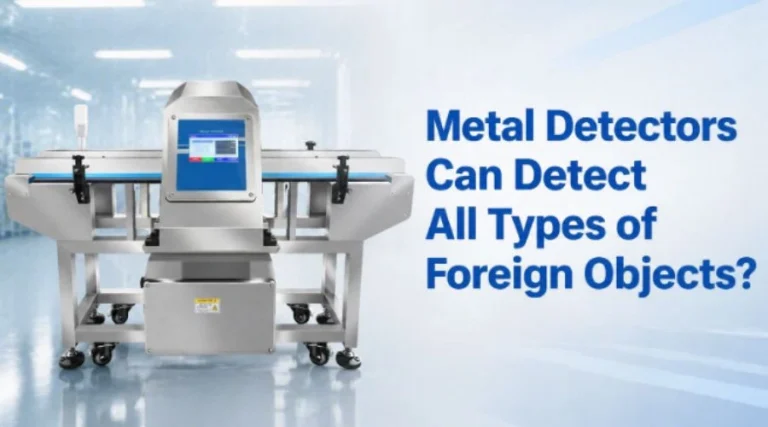
Often, buyers ask us: “Can metal detectors detect plastic?” or “Do metal detectors detect liquid?” To maintain high E-E-A-T standards, we must be blunt: No.
What Can a Metal Detector Detect?
The technology is strictly limited to materials that interact with electromagnetic fields.
Can metal detectors detect plastic? No. Plastic is an insulator.
Can metal detectors detect liquid? No, not as a contaminant. However, do metal detectors detect liquid in terms of “product effect”? Yes.
Do metal detectors detect alcohol? Alcohol itself is non-conductive, but the water and minerals often found in alcoholic beverages can trigger a “wet product” signal.
What do metal detectors detect specifically? They detect Ferrous (iron), Non-Ferrous (copper, lead, aluminum), and Stainless Steel. If your goal is the detection of metal, these machines are perfect. If you need to find glass or stone, you require X-ray technology.
Myth #3: High Sensitivity Always Leads to Better Safety
In the food industry, there is a dangerous assumption that cranking up the metal detector sensitivity food industry settings is always better. However, sensitivity must be balanced against “Product Effect.”
The Product Effect and Liquid Detection
Can metal detectors detect liquid? As established, they don’t detect the liquid itself, but they do react to the conductivity of the liquid. Salty water, blood in meat, or even high moisture in bread creates a signal that looks like metal to the machine.
If you are wondering do metal detectors detect liquid, consider this: a jar of pickles has a higher “product effect” than a dry box of crackers. If the sensitivity is too high, the machine will reject every jar because it “detects” the conductivity of the brine. This is why how do metal detectors work in food industry settings involves “Phasing”—the ability to ignore the product’s natural conductivity to see the metal hidden within.
Myth #4: Aluminum Foil Stops All Metal Detection Methods
While does aluminum foil stop metal detectors of the standard balanced-coil variety, it does not stop specific specialized systems.
Ferrous-in-Foil Detectors
If you must use aluminum foil packaging, you use a “Ferrous-in-Foil” detector.
How it works: These systems use static magnetic fields rather than high-frequency oscillating fields.
The Result: They ignore the aluminum (which is non-magnetic) and only trigger when a magnetic (Ferrous) metal passes through.
So, can aluminum packaged be detected by metal detector units of this type? No. The machine is intentionally designed so metal detector aluminum does not trigger it, allowing you to find the steel screw inside the foil-wrapped chocolate.
Myth #5: Metal Detectors are "Set and Forget" Technology
Many facilities fail audits because they treat metal detectors food processing equipment as a static tool. Real-world accuracy requires constant validation using metal detector test cards food industry.
The Importance of Test Cards
A metal detector test cards food industry kit contains certified spheres of Ferrous, Non-Ferrous, and Stainless Steel.
Experience-Driven Data: We have seen plants where the machine was “on” but the sensitivity had drifted so far that it couldn’t detect a 2.0mm Stainless Steel nut.
Calibration: Regular testing ensures that what can a metal detector detect remains consistent with your HACCP plan.
How to Calibrate Your Metal Detector for Conductive Products?
Tools
Steps to
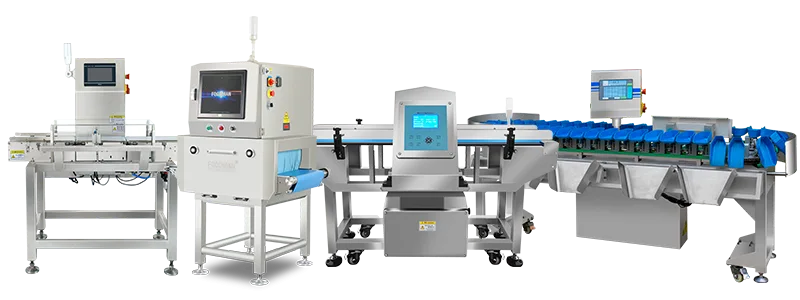
Integrated Solutions: Combination Metal Detection and Checkweigher Systems
In 2026, the trend is moving away from standalone units toward combination metal detection and checkweigher systems.
Why Combine?
Space Efficiency: One frame for two critical control points.
Data Synergy: How do metal detectors work better when paired with a checkweigher? The system can correlate a metal reject with a specific weight batch, helping to trace the source of the contamination (e.g., a broken part from a specific filler).
Cost: Wholesale industrial metal detectors are often more affordable when purchased as a combo.
FAQs
Do metal detectors detect liquid or alcohol in food processing?
Do metal detectors detect liquid? Not as a foreign object, but liquids can cause a “product effect.” Because salty or mineral-rich liquids are conductive, the machine might “see” the liquid and trigger a false alarm. Similarly, do metal detectors detect alcohol? Alcohol itself is less conductive than water, but the overall moisture content in the product can impact metal detector sensitivity food industry settings. High-quality metal detectors food processing units use phase-tracking to ignore the liquid signal and focus on the detection of metal.
What is the benefit of combination metal detection and checkweigher systems?
Combination metal detection and checkweigher systems are integrated units that provide two critical control points (CCPs) in one machine. They perform the detection of metal while simultaneously verifying the product weight. This is a space-saving solution for factories that need to ensure both “what can a metal detector detect” compliance and accurate packaging weight in a single production step.
What can a metal detector detect if the product is already wrapped in foil?
What can a metal detector detect in this scenario is limited. If you use a standard detector, does aluminum foil set off metal detectors? Yes, it will reject every package. However, a “Ferrous-in-Foil” detector can ignore the aluminum and specifically look for magnetic (Ferrous) metals. So, while it won’t find a copper or aluminum shard, it will find a steel screw hidden inside the foil.