
Introduction
In the high-stakes business of food processing and drug manufacturing, millions of safe products often come down to one question: What do metal detectors detect?
It seems like a simple query. However, to QA Managers and Plant Engineers, the solution is a continuum of conductivity, magnetic permeability and signal frequencies. If you mean whether: Can metal detectors detect plastic?) or perhaps asking ”Does aluminum foil detected by metal detectors?”, you’re getting into the physics that underpin food safety as we know it today.
At Easyweigh, we don’t just sell machines; we engineer certainty. This comprehensive guide will dismantle the myths surrounding detection of metal, explain how a metal detector works at a granular level, and provide the specific data you need to optimize your production line. Whether you are battling “product effect” in cheese or trying to detect stainless steel in a vacuum-sealed bag, this is your blueprint.
How Do Metal Detectors Work?

To understand what can a metal detector detect, we must first answer: How do metal detectors work?
At its heart, an industrial metal detector is an electromagnetic instrument. It does not “see” metal in the way an X-ray sees density. Instead, it “feels” the disturbance in a magnetic field.
The Balanced Coil System
Most metal detectors food processing units utilize a “Balanced Coil” architecture. This consists of three coils wrapped around the aperture (the tunnel the food passes through):
The Transmitter Coil: Located in the center, this coil broadcasts a radio frequency signal, creating an electromagnetic field.
The Receiver Coils (x2): Located on either side of the transmitter, these are wound in opposition.
When the system is perfectly balanced (i.e., when the tunnel is empty), the signal received by the two coils cancels out to zero. There is silence.
However, when a metallic object enters the tunnel, it disrupts this magnetic field. The metal absorbs energy and re-transmits it (for magnetic metals) or creates eddy currents (for conductive metals). This unbalances the coils, creating a voltage signal that the machine interprets as a contaminant.
This fundamental principle dictates what do metal detectors detect. They detect conductivity and magnetic permeability. If an object is neither conductive nor magnetic, it is invisible to the machine. This is why the question “can metal detectors detect plastic” is answered with a resounding “No”—unless that plastic is impregnated with metal additives.
The Three Pillars of Metal Detection: Ferrous, Non-Ferrous, and Stainless Steel

Not all metals are created equal. In the food industry, we categorize contaminants into three distinct classes based on how easily they are detected. Understanding this hierarchy is critical for setting your metal detector sensitivity food industry standards.
Ferrous Metals (Fe)
Examples: Carbon steel, iron, cast iron.
Detectability: High (Easiest to detect).
Physics: Ferrous metals are both magnetic and conductive.
Ferrous metals are the “low hanging fruit” of detection of metal. Because they are magnetic, they attract the magnetic field lines of the detector, creating a massive disturbance. You can detect very small spheres of Ferrous metal (often down to 0.8mm or smaller) because the signal is so strong.
Non-Ferrous Metals (Non-Fe)
Examples: Aluminum, Copper, Brass, Lead.
Detectability: Medium.
Physics: Highly conductive but non-magnetic.
This brings us to a common query: Will a metal detector detect aluminum? Yes, absolutely. Metal detector aluminum sensitivity is excellent because aluminum is one of the most conductive metals on earth.
When aluminum passes through the detector, the electromagnetic field induces strong “eddy currents” on its surface. These currents create their own magnetic field, which opposes the detector’s field. The machine sees this as a clear signal. So, can aluminum be detected by metal detector systems? Yes, and often very easily, provided the aluminum is a solid contaminant and not a thin sheet (more on foil later).
Stainless Steel (SUS)
Examples: 304 series, 316 series (Food Grade).
Detectability: Low (Most difficult).
Physics: Generally non-magnetic and poor conductivity.
Stainless steel is the nemesis of the food industry. Most food processing equipment—from knives to conveyor belts—is made of 304 or 316 stainless steel.
The Paradox: These grades of stainless steel are austenitic, meaning they are non-magnetic. They are also poor conductors of electricity compared to copper or aluminum.
The Result: A metal detector struggles to generate eddy currents in them, and there is no magnetic effect to disturb the field. Consequently, you typically need a larger sphere of stainless steel (e.g., 1.0mm or 1.2mm) to trigger the same signal as a 0.8mm Ferrous sphere.
Can Metal Detectors Detect Other Foreign Objects?

Will aluminum foil set off a metal detector?
One of the most frequently searched topics in our industry revolves around aluminum foil. We see these questions constantly:
“Will aluminum foil set off a metal detector?”
“Does aluminum foil set off metal detectors?”
“Does aluminum foil stop metal detectors?”
Let’s break this down with scientific precision, as this is a critical aspect of how do metal detectors work in food industry applications.
Scenario A: Solid Aluminum Contaminant
If a piece of aluminum machinery breaks off and falls into your product, will a metal detector detect aluminum? Yes. As established, solid aluminum is highly conductive. It will trigger an immediate reject.
Scenario B: Aluminum Foil Packaging
So, does aluminum foil stop metal detectors? In a standard system, yes. The foil acts as a “Faraday Cage.” It shields the product inside from the electromagnetic field. If there is a steel nut inside a foil-wrapped burrito, a standard metal detector might not see the nut because the signal from the foil wrapper is overwhelming, or the field simply doesn’t penetrate well.
The Solution: Ferrous-in-Foil Detectors
To solve this, the industry uses specialized “Ferrous-in-Foil” detectors. These machines switch off the high-frequency signal used for non-ferrous detection and use a static magnetic field or very low frequency.
How it works: It ignores the aluminum (non-ferrous) and looks only for magnetic metals (Ferrous) inside the foil.
The Non-Metal Frontier: Plastic, Glass, and Bone
We must address the limitations. What can a metal detector detect beyond metal?
No. Standard plastic (polyethylene, polypropylene, etc.) is non-conductive and non-magnetic. It is invisible to a metal detector.
Can Metal Detectors Detect Glass or Bone?
No. Glass and bone are invisible to electromagnetic fields.
The Solution: This is where you need an X-Ray Inspection System. X-ray detects density, not conductivity. If you need to find glass in a jar or bone in a chicken breast, you must switch technologies.
Liquids, Conductivity, and "Product Effect"

A common misconception is that metal detectors only react to metal. In reality, they react to conductivity. This leads to the critical question: Can metal detectors detect liquid? or Do metal detectors detect liquid?
The answer is nuanced. The detector does not “detect” the liquid as a contaminant, but the liquid can confuse the detector. This is known as Product Effect.
The Wet vs. Dry Battle
ry Products (Flour, Rice, Frozen Food): These are non-conductive. They are “transparent” to the metal detector. You can run high sensitivity because the product generates zero signal.
Wet/Conductive Products (Cheese, Fresh Meat, Warm Bread): These contain moisture and salt. Salt water is conductive.
Do metal detectors detect alcohol? Alcohol itself is less conductive than salt water, but many alcoholic beverages contain water and dissolved minerals. So, while the machine won’t flag pure alcohol as metal, a bottle of wine or beer creates a “product signal” that looks remarkably like stainless steel to the detector.
Phasing Out the Noise
To handle this, modern metal detectors food processing systems use “Phase Discrimination.” The signal from the food (liquid/conductive) has a specific “phase angle.” The signal from a metal contaminant has a different phase angle. The detection of metal relies on the machine’s ability to ignore the phase angle of the cheese or meat while still listening for the phase angle of a metal shard.
This is why metal detector sensitivity food industry settings must be calibrated specifically for wet products.
Advanced Detection: Combination Systems and Test Wands
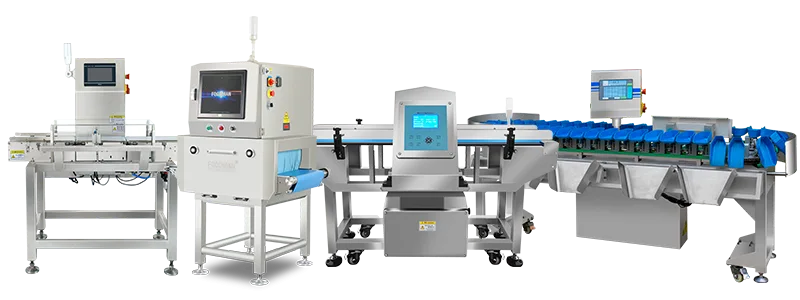
In high-efficiency lines, space is money. This has led to the rise of combination metal detection and checkweigher systems.
The Power of Combination
A combination metal detection and checkweigher systems unit mounts the metal detector head on the same conveyor frame as the weigh cell.
Efficiency: It performs two critical critical control point (CCP) checks in one footprint.
Logic: The system can reject a product for being “underweight” (Checkweigher) or “contaminated” (Metal Detector) using different reject bins, giving QA distinct data streams.
Validating with Test Wands
How do you know the machine is working? You must use metal detector test wands food industry. These are certified plastic sticks containing a specific sphere of metal (e.g., 0.8mm Fe, 1.2mm Non-Fe, 1.5mm SS).
The Test: You pass the wand through the aperture with the product.
The Requirement: The machine must reject the product every time.
Step-by-Step Guide: Optimizing Metal Detection Sensitivity
How to Optimize Metal Detector Sensitivity for Food Processing?
A step-by-step guide to maximizing detection of metal while minimizing false rejects using Phase discrimination.
Required Tools:
Tool:
Steps to configure the HowTo widget:
Conclusion
To summarize the definitive answer to what do metal detectors detect:
They Detect: All conductive and magnetic metals. This includes Iron, Steel, Aluminum, Copper, Brass, Gold, Silver, and Stainless Steel (to varying degrees).
They DO NOT Detect: Plastic, Glass, Wood, Bone, Rubber, or Liquids (unless the liquid is conductive enough to cause a false reject, but it is not “detected” as a contaminant).
The Aluminum Factor: Does aluminum foil set off metal detectors? Yes, it causes massive interference unless you use a specific Ferrous-in-Foil machine. Will a metal detector detect aluminum contaminants? Yes, with high sensitivity.
The Liquid Factor: Do metal detectors detect liquid? They see the conductivity of the liquid, which complicates detection, but they do not identify the liquid itself as a foreign object.
Navigating the physics of detection of metal is difficult. Whether you need a simple conveyor system or complex combination metal detection and checkweigher systems, Easyweigh provides the expertise to balance sensitivity with stability. We understand how a metal detector works because we build them from the coil up. Don’t guess about what can a metal detector detect. Know for sure.
FAQs
Can metal detectors detect plastic or glass?
No. A common misconception is asking, “Can metal detectors detect plastic?” Standard industrial metal detectors operate on electromagnetic conductivity and magnetism. Since plastic, glass, bone, and rubber are non-conductive and non-magnetic, they are invisible to the machine.
The Exception: If you use metal detector test wands food industry or plastic tools (like scrapers) that are made of “Metal Detectable Plastic,” the detector can identify them because they are impregnated with metallic dust.
Do metal detectors detect liquid or alcohol?
This depends on the definition of “detect.” Can metal detectors detect liquid as a contaminant? No. But do metal detectors detect liquid product effect? Yes. Liquids—especially those with salt or minerals—are conductive. Do metal detectors detect alcohol? Yes, because beverages like beer or wine have high conductivity. The machine sees this “wet” signal as potential metal (Product Effect). To prevent false rejects, modern metal detectors food processing units use “Phase Discrimination” to ignore the specific conductivity signal of the liquid product while still watching for metal contaminants.
What are combination metal detection and checkweigher systems?
Combination metal detection and checkweigher systems are integrated units that perform two critical quality checks in a single footprint. The product first passes through the metal detector head for detection of metal, and then immediately moves onto a weigh cell to ensure it meets weight regulations. This setup is popular in metal detectors food processing lines where floor space is limited, providing streamlined compliance for both HACCP and Weights & Measures.