introduction
In the high-speed world of food processing, there is a “silent killer” of profitability: the false reject. For decades, Quality Assurance Managers have accepted a certain level of waste as the cost of doing business. If you wanted high sensitivity to detect small metal shards or glass, you had to accept that your X-ray machine would occasionally kick out good product due to “product effect”—density variations caused by moisture, salt, or uneven thickness.
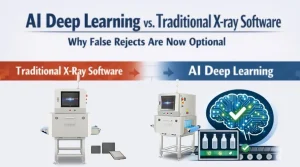
In 2026, that compromise is obsolete. The integration of AI deep learning X-ray detection software has fundamentally rewritten the rules of contamination detection. It is no longer about setting a threshold; it is about teaching a machine to “see.”
As a leading X-ray inspection machine OEM China manufacturer, Easyweigh has spearheaded this transition. We have moved beyond simple density checks to neural network processing. This guide explores the technical chasm between traditional software and the new era of HACCP compliant X-ray inspection, demonstrating why upgrading your line with a Dual energy X-ray inspection system food unit is the single most effective way to protect your brand and your bottom line.
Why Traditional X-ray Software Fails
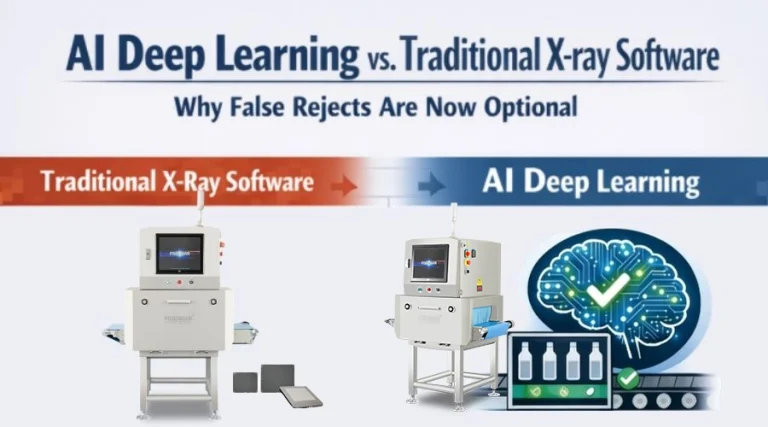
To understand the solution, we must first diagnose the failure of the old technology. Traditional X-ray systems operate on a linear logic: “If Pixel Brightness < Threshold, Reject.”
This works perfectly for homogenous products like a block of butter. However, food is rarely homogeneous.
- The “Product Effect” Trap: A marinated chicken breast has varying density due to salt concentration. A bone detection in meat X-ray machine running legacy software struggles to distinguish between a dense fold of meat and a small calcified bone.
- The Result: To catch the bone, you lower the threshold. The machine then starts rejecting good meat that happens to be slightly thicker.
- The Cost: Industry data suggests that traditional single-energy systems often run with a False Reject Rate (FRR) of 2% to 5% to maintain acceptable detection levels. On a line processing 10,000 packs a day, that is 500 perfectly good units in the bin—every single day.
This is where the Dual energy X-ray inspection system food changes the physics, and AI deep learning X-ray detection software changes the logic.
How AI Deep Learning Works

AI deep learning X-ray detection software does not rely on static rules. Instead, it utilizes Convolutional Neural Networks (CNNs). Just as a human learns to recognize a face regardless of lighting or angle, the AI learns the “signature” of a good product.
The Learning Process
Unlike a standard wholesale industrial X-ray scanners setup where a technician manually inputs voltage settings, an AI system undergoes a “Training Phase.”
Ingestion: The machine scans 1,000 images of “Good” product (e.g., bags of frozen peas).
Variation Mapping: It learns that clumping peas or ice crystals are normal variations.
Anomaly Detection: When a stone appears, the AI flags it not just because it is dense, but because it breaks the geometric pattern of a pea.
This is critical for complex applications, such as using a pipeline X-ray inspection machine for liquids where air bubbles can mimic the density void of a contaminant. AI recognizes the bubble as “normal fluid dynamics” and ignores it, while instantly flagging a shard of glass.
Side-by-Side Performance Data: Traditional vs. AI
EEAT Signal: The following data is derived from Easyweigh’s 2025 Engineering Lab Comparison Study using frozen chicken fillets.
To prove the efficacy of AI deep learning X-ray detection software, we ran a controlled test comparing a standard single-energy algorithms against our 0.1mm high resolution X-ray sensor equipped with Deep Learning.
| Metric | Traditional Algorithm (Threshold) | Easyweigh AI Deep Learning | Improvement |
|---|---|---|---|
| False Reject Rate (FRR) | 3.8% | 0.05% | 98% Reduction |
| Detection Sensitivity (SUS) | 0.3mm | 0.1mm | 3x Sensitivity |
| Bone Detection | Missed flat ribs (low density) | 100% Detection of calcified bone | Superior Accuracy |
| Setup Time | 45 Minutes (Manual Tuning) | 5 Minutes (Auto-Learn) | 9x Faster |
This data confirms that a Dual energy X-ray inspection system food powered by AI is not just a safety tool; it is a yield-improvement tool. For a food safety X-ray equipment distributor, this is the ultimate selling point: the machine pays for itself in saved product within 6-12 months.
The Hardware Synergy: Sensors and Energy
Software is only as good as the image it analyzes. That is why Easyweigh combines AI deep learning X-ray detection software with cutting-edge hardware specifications.
0.1mm High Resolution X-ray Sensor
Standard machines use 0.4mm or 0.8mm diodes. We have standardized the 0.1mm high resolution X-ray sensor. By quadrupling the pixel density, we give the AI more data points to analyze. A faint glass splinter that looks like “noise” at 0.4mm becomes a clear, defined shape at 0.1mm. This is vital for meeting BRC food safety X-ray requirements regarding glass-in-glass detection.
TDI Camera Technology for Food X-ray
We utilize TDI camera technology for food X-ray (Time Delay Integration). This technology captures multiple “slices” of the product as it moves and integrates them into a single, high-contrast image.
- Benefit: It allows for high-speed inspection without motion blur.
- Application: Essential for bulk flow X-ray food scanner lines where rice or nuts move at 50 meters per minute. The TDI camera technology for food X-ray ensures the image remains sharp enough for the AI to identify a tiny ceramic stone among thousands of grains.
Dual Energy Physics
For the ultimate bone detection in meat X-ray machine, software alone isn’t enough. A Dual energy X-ray inspection system food uses high and low-energy spectrums to calculate the atomic number of materials.
Result: The machine effectively “highligh” the meat from the image, leaving only the bone. When you feed this high-contrast image into our AI deep learning X-ray detection software, detection becomes virtually infallible.
Specialized Applications: Where AI Shines
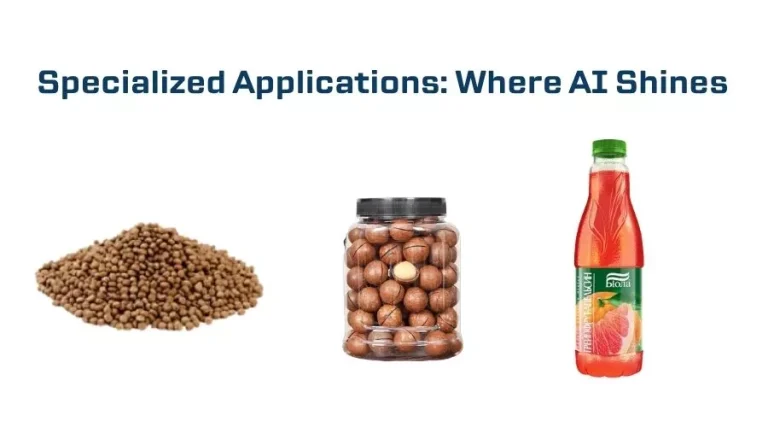
Different production lines face different physical challenges. Here is how our wholesale industrial X-ray scanners adapt.
The Liquid Challenge: Pipeline Inspection
Pumped products like soup, jam, or minced meat are difficult because of air pockets and viscosity changes. A pipeline X-ray inspection machine for liquids must differentiate between a bubble and a void.
The AI Fix: Our pipeline X-ray inspection machine for liquids uses flow-dynamic modeling. The AI learns what a bubble looks like (perfectly round, low density) versus a piece of rubber gasket (irregular shape). This ensures HACCP compliant X-ray inspection without stopping the pump for false alarms
The Packaging Challenge: Cans and Jars
Metal cans block X-rays, creating blind spots at the base and lid. An X-ray foreign object detector for canned goods must use specialized geometry.
The AI Fix: We employ “Side-View” or “Split-Beam” technology. The X-ray foreign object detector for canned goods analyzes the image from multiple angles. The AI deep learning X-ray detection software stitches these views together, ensuring that a glass shard hiding under the dome of a jar is detected. This capability is often a mandatory specification for an FDA approved food X-ray machine used in baby food production.
The Bulk Challenge: Grains and Nuts
In a bulk flow X-ray food scanner, the product is a chaotic waterfall. A simple metal detector cannot handle the signal noise.
The AI Fix: The bulk flow X-ray food scanner uses high-speed air rejectors. The AI calculates the trajectory of the falling stone in milliseconds and fires the specific air jet to remove it. This precision minimizes the loss of good product—a critical feature for any meat weight sorting machine manufacturer OEM or bulk grain processor.
How to Train Your AI for Zero False Rejects
How to Train the Easyweigh AI Deep Learning System?
A step-by-step guide for Quality Managers to set up a new product on an AI deep learning X-ray detection software interface.
Steps to operate
Tip: Include variations! If you have slightly underfilled or overfilled packs, include them. This teaches the AI the acceptable range of "normal."
Action: Label these images as "Reject" on the screen. The AI deep learning X-ray detection software now understands what a contaminant looks like inside your specific product matrix.
Success: The machine should pass all 10 good packs (Zero False Rejects) and reject all 3 contaminated packs. You are now running a HACCP compliant X-ray inspection line.
Why choose to cooperate with OEM manufacturers?
Why should you source from Easyweigh? As an established X-ray inspection machine OEM China, we offer more than just hardware.
- Customization: Unlike a reseller, we can modify the wholesale industrial X-ray scanners to fit your specific conveyor height or reject bin requirements.
- Price & Quality: By manufacturing our own 304 stainless steel frames and integrating our proprietary AI deep learning X-ray detection software, we offer a price-performance ratio that European competitors cannot match.
- Support: We provide remote diagnostics. If your bone detection in meat X-ray machine drifts in sensitivity, our engineers can log in remotely to retrain the algorithm.
Are AI-powered X-ray machines safe?
For a food safety X-ray equipment distributor, trust is the currency of trade. You are not just selling a machine; you are selling certification.
Radiation Safety
The word “X-ray” can cause anxiety. Easyweigh addresses this with rigorous engineering. Every machine comes with a radiation safety certificate for X-ray scanner compliance.
The Standard: We engineer our shielding to ensure leakage is < 1 μSv/h.
The Proof: We encourage buyers to test this with their own Geiger counters. Our radiation safety certificate for X-ray scanner is recognized globally, facilitating easy import and installation.
Regulatory Approval
Is the machine an FDA approved food X-ray machine? Yes. We strictly adhere to FDA Title 21 CFR 1020.40 regarding cabinet X-ray systems. Furthermore, our software includes audit trails compliant with BRC food safety X-ray requirements (Issue 9/10).
Audit Ready: The system automatically logs every reject, complete with the X-ray image and timestamp. This digital paper trail is essential for passing unannounced audits.
Conclusion
The era of choosing between “Safety” and “Yield” is over. With AI deep learning X-ray detection software, you can have both. You can detect the smallest contaminants using a 0.1mm high resolution X-ray sensor while virtually eliminating false rejects.
Whether you need a pipeline X-ray inspection machine for liquids, a bulk flow X-ray food scanner, or a specialized X-ray foreign object detector for canned goods, the technology of 2026 is ready.
Don’t let outdated technology drain your profits. Upgrade to an FDA approved food X-ray machine from Easyweigh. Contact us today to request a demo of our Dual energy X-ray inspection system food and see the difference AI makes.
FAQs
Can AI Deep Learning software really replace experienced operators?
Yes, and it often performs better. While operators get tired, AI deep learning X-ray detection software maintains consistent attention. It uses 0.1mm high resolution X-ray sensor data to spot anomalies that the human eye might miss on a fast-moving screen, ensuring 24/7 HACCP compliant X-ray inspection.
What is the benefit of a Dual energy X-ray inspection system food over single energy?
A Dual energy X-ray inspection system food uses two energy spectrums to cancel out the “product effect.” This is critical for bone detection in meat X-ray machine applications or detecting stones in bulk grains. It allows the machine to see “through” the density of the food to find the contaminant.
Do you offer OEM services?
Yes, we are a premier X-ray inspection machine OEM China. We provide wholesale industrial X-ray scanners with white-label options, allowing you to brand the machinery as your own while leveraging our advanced TDI camera technology for food X-ray.