
Introduction
Now implement a food x-ray machine as today the consumer safety and protection of brands from contamination is more important than ever. But, putting into service of food X-ray inspection equipment cannot ensure 100% accuracy. However, the theoretical sensitivity of an x-ray inspection machine will compete against all of the unpredictable imputs that occur in a real factory environment.
Easyweigh which is a leading player in the food x-ray inspection sector knows that understanding the physics behind how these machines work is very important for quality managers. Whether you work with poultry bone detection x-ray or canned food x-ray inspection, multiple environment and product-specific factors influence the effectiveness of your x-ray detection system. This guide explores the critical variables that impact food x-ray detection and how to optimize your x-ray inspection systems for peak performance.
Product Density Variation: The Primary Challenge

The fundamental principle of food x-ray inspection is the measurement of density. An x-ray inspection system identifies contaminants because they are typically denser than the surrounding food. However, when the product itself has high product density variation, the food x-ray machine may struggle to distinguish between a natural dense spot in the food and a foreign object.
In poultry bone detection x-ray, for example, the muscle tissue and the bone have very similar densities. If the breast meat varies in thickness, the x-ray technology in low-density food inspection must be sophisticated enough to “filter out” the thick meat sections to find the actual bone. High-quality food x-ray inspection systems use advanced algorithms to compensate for these natural fluctuations, ensuring that food x-ray detection remains accurate despite the organic nature of the product.
The Impact of Moisture, Salt, and Temperature

Unlike an x-ray metal detector, a food x-ray inspection system is generally not affected by “product effect” caused by conductivity. However, moisture and salt content can still influence the overall density profile.
Moisture and Salt: High levels of brine in x-ray packaged food can increase the absorption of x-rays. In x-ray inspection of food through a pipeline, consistent moisture is key. If the salt concentration varies wildly, the x-ray food inspection software might require frequent recalibration to avoid false rejects.
Temperature: While temperature doesn’t change the density significantly, it can affect the physical state of the product (e.g., frozen vs. thawed). Frozen blocks of meat have a very different “image texture” in a food x-ray machine than fresh meat, which affects food inspection with x-ray sensitivity for small fragments.
Package Overlap and Product Orientation
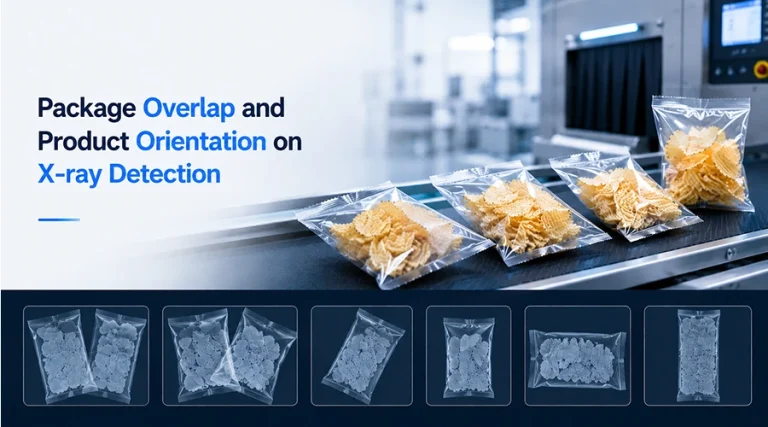
In a high-speed environment, how the product sits on the conveyor is vital. X-ray food packaging that overlaps can create a “double density” zone. When two bags of x-ray packaged food overlap, the x-ray detection system sees a dark area that looks like a large contaminant.
Product orientation is equally critical. A thin, flat piece of metal or a needle-thin bone might be easily seen if it is lying flat, but if it is oriented vertically (parallel to the beam), its “footprint” on the sensor is much smaller. Advanced food x-ray inspection systems utilize multi-angle beams or AI software to ensure food x-ray detection regardless of how the contaminant is positioned.
Conveyor Vibration and Contaminant Position

The physical stability of the x-ray inspection machine is often overlooked. Conveyor vibration can blur the x-ray image, much like a shaky camera blurs a photograph. This blurring makes it nearly impossible for the x-ray detection system to identify tiny contaminants like 0.8mm stainless steel or small shards in canned food x-ray inspection.
Furthermore, the contaminant position within the product matters. A stone at the very bottom of a thick container is harder to detect than one in the middle due to the way x-ray beams diverge. This is why food inspection with x-ray is often paired with dual beam technology to ensure mass consistency alongside safety.
Industrial Integration: X-Ray Inspection of Food Through a Pipeline
For high-viscosity products like sausages or pastes, the most effective method is x-ray inspection of food through a pipeline. This method eliminates many of the issues mentioned above, such as package overlap and product orientation.
By using x-ray inspection of food through a pipeline, the product is presented to the food x-ray machine in a uniform, controlled flow. This allows the x-ray inspection for food industry hardware to operate at maximum sensitivity, catching bone fragments and metal that might be hidden if the product were already inside food x-ray packaging.
How to Maintain X-Ray Performance on Your Line
To get the most out of your food x-ray inspection equipment, follow these steps.
- Standardize Product Flow & Calibrate for Product Density: Ensure your x-ray packaged food is spaced evenly to prevent package overlap. Run test pieces to adjust your x-ray inspection system for the specific product density variation of your batch.
- Minimize Vibration: Secure the x-ray inspection machine to a stable floor and ensure the x-ray checkweigher components are balanced.
- Optimize Beam Power: Adjust the voltage of your food x-ray machine to penetrate the thickest part of your x-ray food packaging without washing out the image.
- Routine Maintenance: Check the x-ray detection system sensors and the x-ray metal detector dual-capability components weekly.
Conclusion: The Easyweigh Commitment to Accuracy
Achieving peak food x-ray inspection performance requires a deep understanding of both physics and the production environment. Factors like salt content, moisture, and conveyor vibration are challenges, but with the right food x-ray inspection systems, they are manageable.
At Easyweigh, we design our x-ray inspection for food industry solutions to thrive in real-world conditions. From x-ray technology in low-density food inspection to integrated x-ray checkweigher systems, our goal is to provide the most reliable food x-ray detection on the market. By controlling these variables, you ensure that your x-ray food inspection is not just a checkbox on a compliance form, but a robust shield for your brand.
Summary of Factors Affecting Food X-Ray Performance:
- Product Density: High variation requires smarter x-ray detection system algorithms.
- Environment: Conveyor vibration must be minimized for clear food x-ray imaging.
- Packaging: Package overlap in x-ray packaged food causes false rejects.
- Pipeline Inspection: X-ray inspection of food through a pipeline offers the highest sensitivity for bulk materials.
By focusing on these details, your food x-ray machine will deliver the high-performance food inspection with x-ray your company deserves.
FAQs
Why is conveyor vibration a critical concern for an x-ray inspection system?
In a real-world production environment, conveyor vibration can degrade the image quality of the food x-ray machine. Much like a blurred photograph, vibration reduces the “sharpness” of the scan, making it difficult for the x-ray detection system to identify tiny contaminants like 0.8mm stainless steel or small glass shards. High-performance x-ray inspection for food industry standards require a stable, vibration-dampened frame to maintain maximum sensitivity at high throughput speeds.
Can x-ray inspection of food through a pipeline solve the issue of package overlap?
Yes. One of the biggest hurdles in x-ray packaged food is package overlap, which creates a “double density” zone that causes false rejects. By utilizing x-ray inspection of food through a pipeline, the product is scanned in a uniform flow before it enters the food x-ray packaging. This ensures that food inspection with x-ray is performed on a consistent volume, significantly increasing the detection rate for poultry bone detection x-ray and other small contaminants.
Does salt content or moisture affect the performance of a food x-ray machine?
While x-ray is less sensitive to salt and moisture than traditional metal detectors, high salt content or extreme moisture can slightly alter the product’s density profile. In x-ray food inspection, these factors are managed through “product learning.” The x-ray inspection system is calibrated to the specific density of the brined or wet product, ensuring that the food x-ray detection software focuses only on foreign bodies and ignores the “product effect.”